


Why Smartphones Cost More in India: AI-Driven Memory Shortage Hits Sales, Budget Phones Worst Affected

India’s smartphone market is going through its toughest year in more than a decade, and the main reason has nothing to do with phones themselves. A worldwide shortage of memory chips, driven by the enormous demand from artificial intelligence data centres, has pushed up the cost of the RAM and storage inside every phone. Brands have passed those costs on to buyers, and buyers have responded by holding on to their old phones.
Table Of Content
- What is happening to smartphone sales in India?
- Why has memory become so expensive?
- How much have phone prices gone up?
- Why budget phones are hit hardest
- What happens next?
- It is not just phones
- What should buyers do?
- The bigger picture
- Quick answers
- Why are smartphones getting more expensive in India?
- How much have India’s smartphone shipments fallen?
- Which phones are most affected?
- Will prices come down soon?
- Verdict
- Sources
Preliminary estimates from Counterpoint Research suggest India’s smartphone shipments fell about 20 percent year on year in July to September 2026, with phones under Rs 20,000 falling 47 percent. IDC expects full-year shipments to drop to between 128 million and 130 million, down from 152 million in 2025. This article explains what is happening, why memory has become so expensive, how it affects what you pay, and what buyers can do about it.
What is happening to smartphone sales in India?
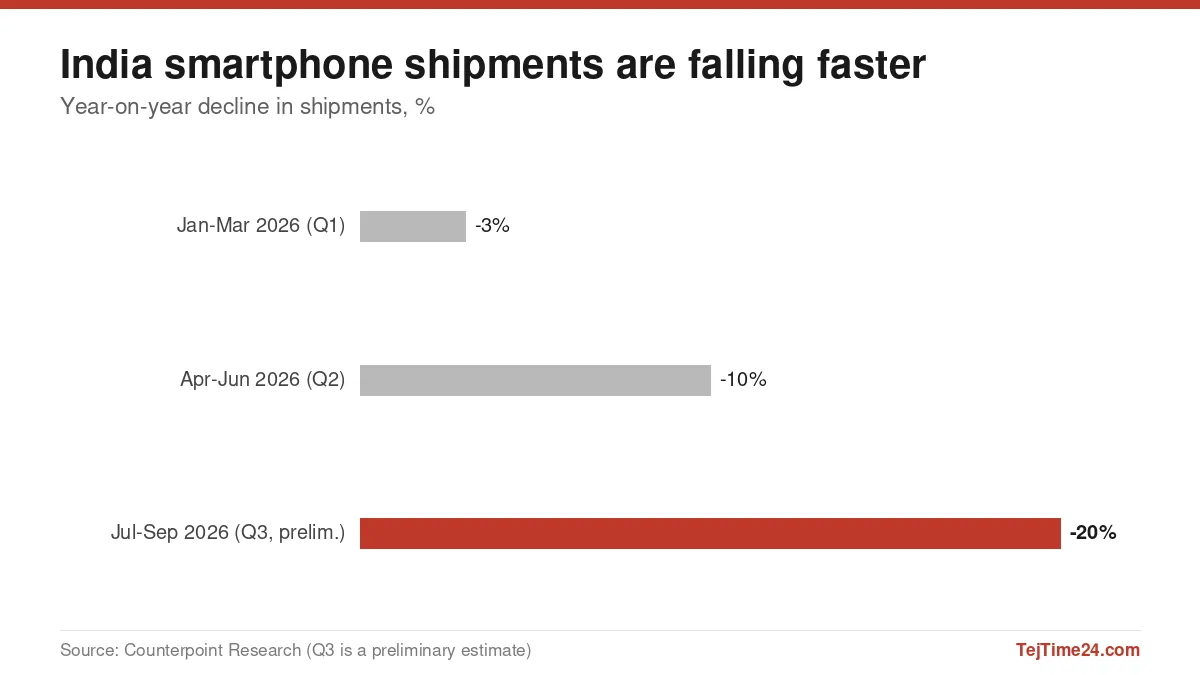
The decline has accelerated through the year:
- January to March: Shipments fell 3 percent year on year, the weakest first quarter in six years according to Counterpoint. IDC put the decline at 4.1 percent.
- April to June: Shipments fell 10 percent, which Counterpoint described as the steepest June-quarter decline in six years.
- July to September: Counterpoint’s preliminary estimates point to a fall of about 20 percent, with the sub-Rs 20,000 segment down 47 percent.
The damage is concentrated at the bottom of the market. In the April to June quarter, phones priced below Rs 15,000, which account for roughly a third of India’s total volumes, fell 45 percent according to Counterpoint. These are the phones most first-time buyers and most price-conscious families depend on.
The festive season, usually the busiest time of year for phone sales, has not been enough to reverse the trend. Analysts say festive growth has been slower than usual, as higher prices have made many buyers hesitate.
Why has memory become so expensive?
Every smartphone contains two main types of memory:
- DRAM, which is the phone’s working memory (RAM), used to run apps and the operating system
- NAND flash, which is the phone’s storage, where apps, photos and files are kept
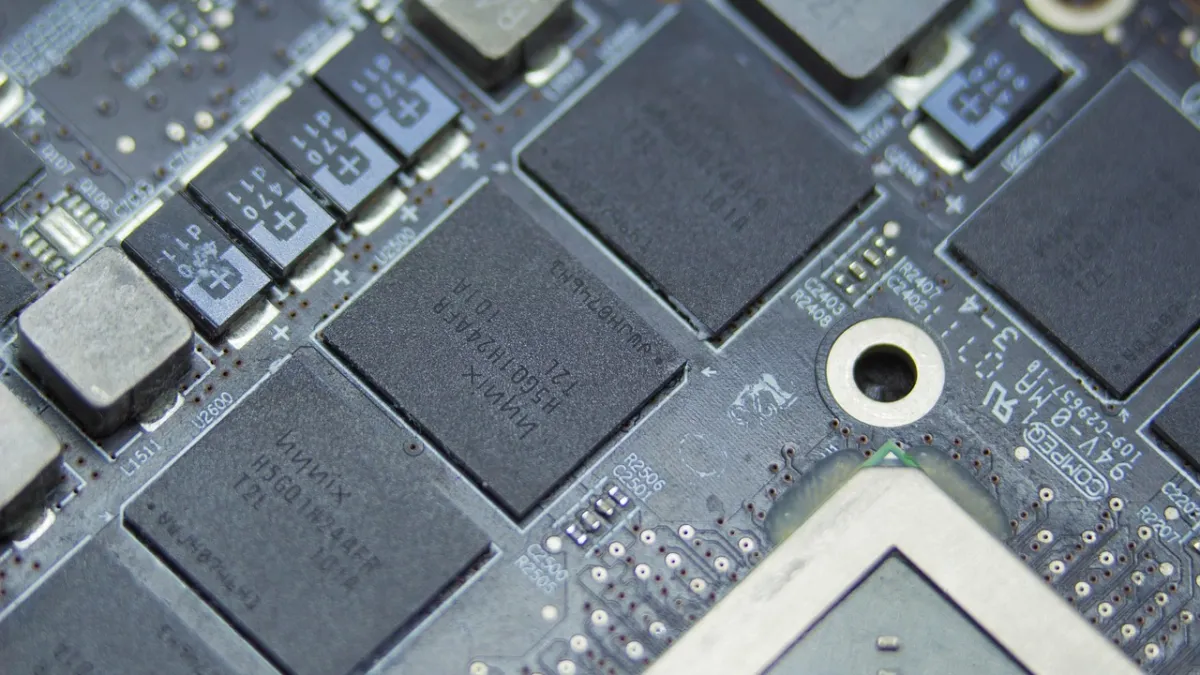
The same manufacturers that make these chips also supply the memory used in AI servers. Over the past year, AI data centres have absorbed the bulk of the world’s DRAM and NAND output. Chipmakers have prioritised high-margin AI memory, leaving less supply for phones and laptops.
The price increases have been dramatic:
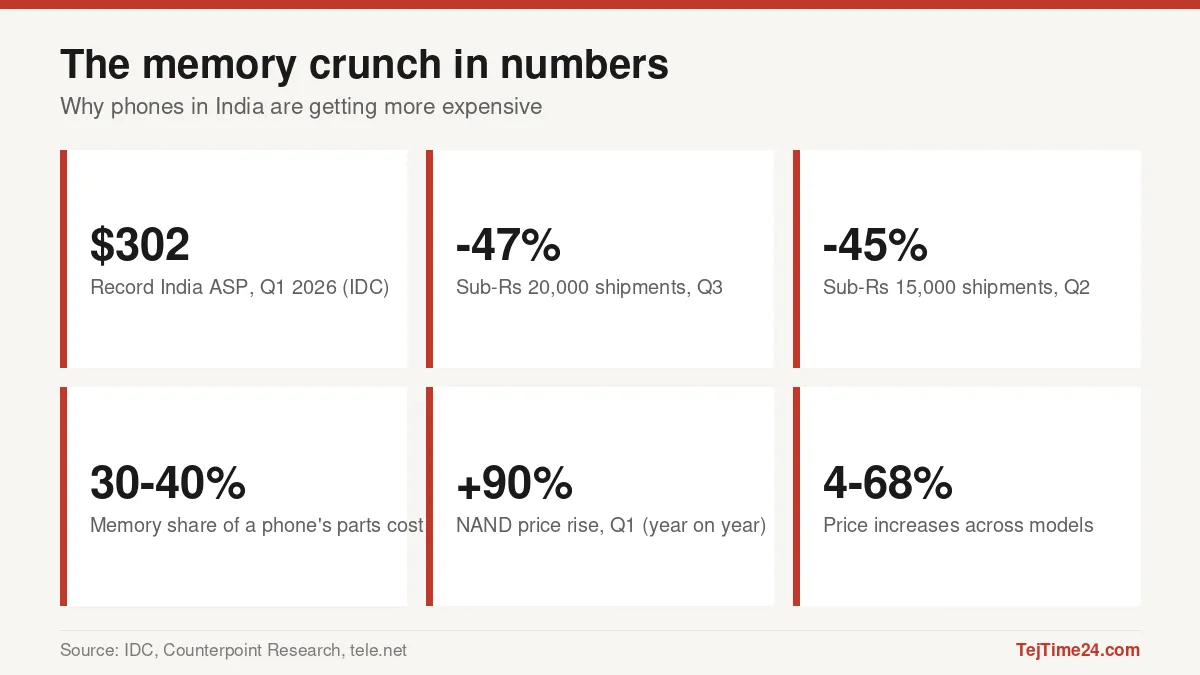
- Global DRAM prices rose more than 50 percent year on year in the first quarter of 2026, and NAND flash prices rose 90 percent.
- Counterpoint says memory prices had risen roughly fourfold by the April to June quarter of 2026.
- Memory now accounts for 30 to 40 percent of a phone’s bill of materials, the total cost of its components.
For India, there is an extra factor. Counterpoint notes that the depreciation of the rupee has compounded the effect, because memory chips are bought in dollars. When the rupee weakens, the cost of imported components rises further.
How much have phone prices gone up?
Brands have responded by raising prices, both on new launches and on phones already on sale. Counterpoint’s Tarun Pathak has said smartphone prices in India have risen by anywhere from 4 to 68 percent, depending on the model.
The average selling price of a smartphone in India reached a record $302 in the first quarter of 2026, a 10.4 percent increase year on year according to IDC. IDC’s Upasana Joshi has said that without the sharp rise in memory prices, India’s average selling price would not be crossing $300 the way it is.
Buyers have also noticed a change in discounts. Reports earlier this year found that, in the first five months of 2026, price increases on smartphones far outpaced price cuts, a reversal from 2025, when increases and cuts were roughly balanced. Discounts that buyers once expected on older models have become less common.
Why budget phones are hit hardest

Memory costs affect every phone, but they hurt cheap phones the most. A premium phone has expensive components across the board, such as a powerful chipset, a high-end display and advanced cameras, so memory is a smaller share of its total cost. In a budget phone, memory is one of the biggest single costs.
Some industry estimates suggest that in budget smartphones, memory can now account for more than half of production costs. That leaves manufacturers with three difficult options:
- Raise prices, which pushes the phone out of reach for many budget buyers
- Cut specifications, such as offering less RAM or storage for the same price
- Accept lower margins, which few brands can sustain in an already thin-margin segment
IDC has warned globally that the sub-$100 smartphone segment could become permanently uneconomical. In India, where budget phones are the gateway to the internet for millions of people, that is a significant concern.
What happens next?
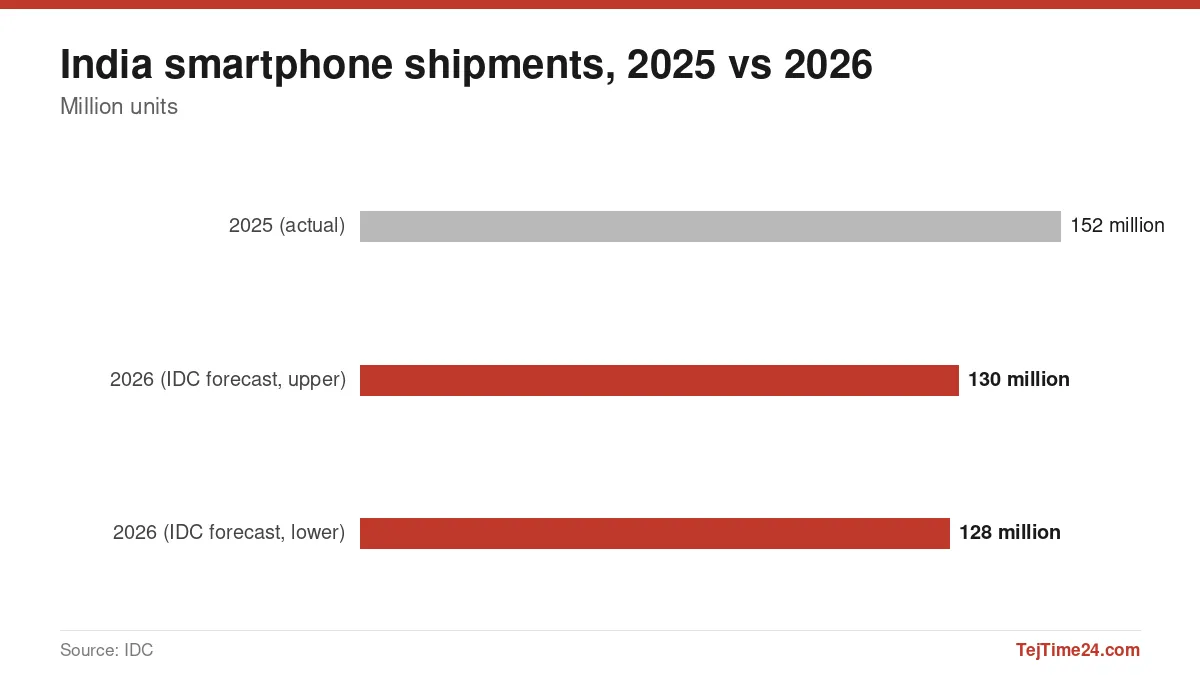
The outlook for the rest of 2026 is weak. IDC projects that India’s shipments will fall more than 15 percent in the second half of the year, taking full-year volumes to between 128 million and 130 million units, down from 152 million in 2025. Counterpoint has forecast a decline of around 13 to 14 percent for the full year.
Globally, the picture is similar. IDC expects worldwide smartphone shipments to fall 12.9 percent to about 1.12 billion units in 2026, from 1.26 billion in 2025. Counterpoint has forecast a decline of around 12 percent, which would take global volumes to their lowest level since 2013.
Analysts expect the shortage to continue for some time, as chipmakers take years to build new factories and AI demand shows no sign of slowing. Some analysts also expect the market to consolidate, as smaller brands struggle to absorb higher costs and larger brands gain share.
It is not just phones
Laptops and other devices are affected too. Analysts have said laptops are likely to see even sharper price increases than smartphones, because they use larger amounts of memory and have higher average prices. Tablets, PCs and other electronics that rely on DRAM and NAND are also exposed.
For consumers, this means that 2026 is an unusual year. The long-running pattern of technology becoming cheaper and better every year has been temporarily interrupted, at least for memory-heavy devices.
What should buyers do?
If you are planning to buy a phone in the coming months, here are some practical tips:
- Do not wait for prices to fall soon. With the shortage expected to continue, prices are unlikely to drop quickly. If you need a phone now, waiting may not save money.
- Compare memory and storage carefully. Some brands may offer less RAM or storage than before at the same price. Check the exact specification, not just the model name.
- Consider last year’s models. Older models already in stock may offer better value, especially if a retailer is clearing inventory.
- Use bank offers and exchange deals. These can still reduce the effective price significantly, even when list prices have risen.
- Look at certified refurbished phones. A refurbished phone from a reputable seller, with a warranty, can be a cost-effective alternative.
- Extend the life of your current phone. A new battery or screen replacement may cost far less than a new phone and buy you another year or two.
The bigger picture
The memory shortage shows how tightly connected the technology industry has become. The rapid growth of AI, which happens largely in data centres far from ordinary consumers, is now directly affecting what an Indian family pays for a basic smartphone.
For India, the impact goes beyond sales numbers. Affordable smartphones have been central to the country’s digital growth, enabling access to digital payments, online education, government services and entertainment. If budget phones become significantly more expensive for a sustained period, it could slow the pace at which new users come online.
Quick answers
Why are smartphones getting more expensive in India?
Mainly because of a global shortage of memory chips (DRAM and NAND), driven by demand from AI data centres. A weaker rupee has added to the cost of imported components.
How much have India’s smartphone shipments fallen?
About 3 percent in Q1 2026, 10 percent in Q2 and around 20 percent in Q3, according to Counterpoint’s figures and preliminary estimates.
Which phones are most affected?
Budget phones. Shipments of phones under Rs 20,000 fell about 47 percent in the July to September quarter, according to preliminary Counterpoint estimates.
Will prices come down soon?
Analysts do not expect a quick reversal, because the shortage is tied to long-term AI demand and new chip capacity takes years to build.
Verdict
The memory crunch has turned 2026 into one of the most difficult years on record for India’s smartphone market. Rising costs have pushed prices up, squeezed the budget segment hardest and caused many buyers to postpone upgrades. With IDC expecting shipments to fall to around 128 to 130 million units this year, the effects will be felt well into 2027.
For buyers, the best strategy is to shop carefully, compare specifications closely and make the most of bank offers, exchange deals and older models. For the industry, the challenge is to keep smartphones affordable for the millions of Indians who rely on them.
Sources
- Open: Shipments fell 20% in July-September (Counterpoint preliminary)
- Free Press Journal: IDC expects H2 2026 shipments to fall over 15%
- TechCrunch: AI-driven memory crunch jolts India’s smartphone market
- Digit: State of the smartphone industry 2026
- Counterpoint Research: Mobile memory cost hikes
- Business Today: IDC global forecast
Featured image designed by TejTime24 in Canva, using a photo by Recklessstudios / Pixabay.
Related: Mivi One 5G launched | OPPO Find X10 Pro Max launched in India