
Renault Duster Strong Hybrid Launched at Rs 16.99 Lakh: 29 kmpl, E-Tech 160 Explained and Rivals

Renault India has launched the Duster Strong Hybrid E-Tech 160 at an introductory price of Rs 16.99 lakh (ex-showroom). It is the first Renault in India with a strong-hybrid powertrain, and it pairs a 1.8-litre petrol engine with two electric motors and a small battery. Renault claims an ARAI-certified fuel efficiency of 29 kmpl and a range of more than 1,400 km on a single tank.
Table Of Content
- Price and variants
- How the E-Tech 160 hybrid works
- Mileage and range
- Performance and drive modes
- Features
- Safety and warranty
- Rivals: Hyryder, Grand Vitara and Victoris
- Why strong hybrids are gaining ground in India
- Hybrid or turbo-petrol Duster?
- Quick answers
- Does the Duster Hybrid need to be plugged in?
- What is the claimed mileage?
- When do deliveries start?
- How long is the battery warranty?
- Verdict
- Sources
The hybrid joins the turbo-petrol Duster, which went on sale earlier at Rs 10.49 lakh. Renault’s goal is clear: take on the established strong-hybrid SUVs from Toyota and Maruti Suzuki, which have so far dominated this niche. Renault’s India CEO has said the expanded powertrain line-up could lift Duster sales fourfold. Here is a full guide to the prices, the hybrid system, real-world implications, features, safety, warranty and rivals.
Price and variants
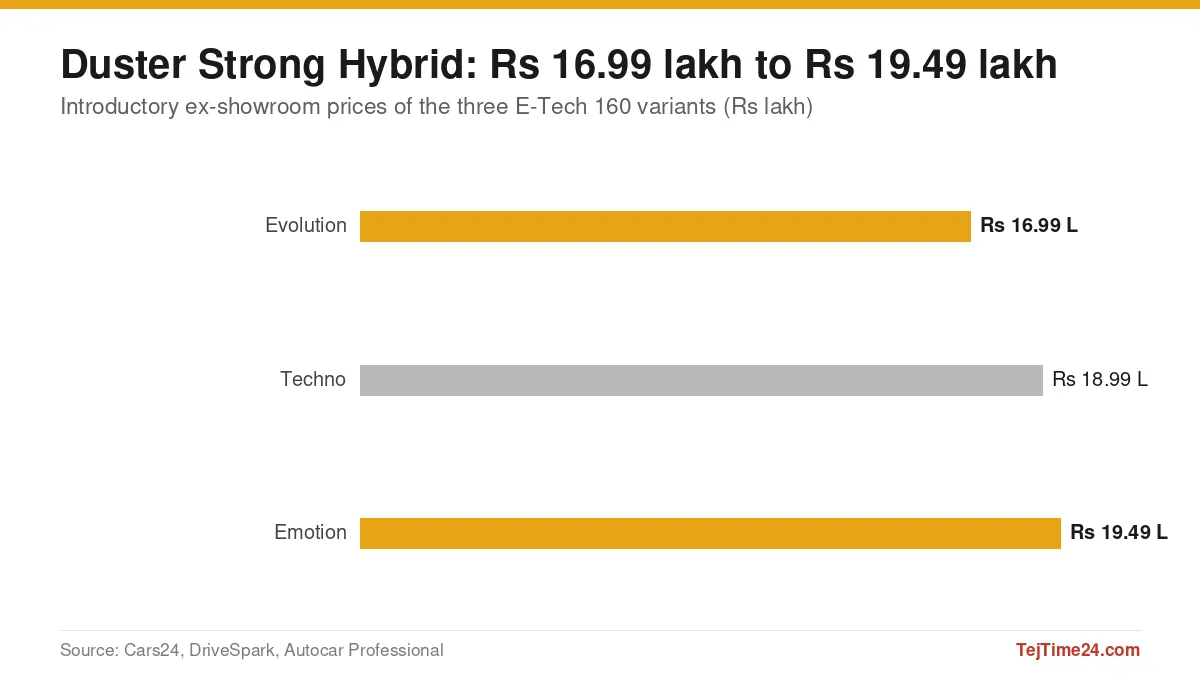
The Duster Strong Hybrid comes in three variants, all with the same E-Tech 160 powertrain.
| Variant | Introductory ex-showroom price |
|---|---|
| Evolution | Rs 16.99 lakh |
| Techno | Rs 18.99 lakh |
| Emotion | Rs 19.49 lakh |
Bookings are open for Rs 21,000, and Renault says deliveries will begin on 6 November 2026, just after Diwali. Before the launch, the hybrid was widely expected to cost between Rs 18 lakh and Rs 22 lakh, so an entry price below Rs 17 lakh is an aggressive opening move. It positions the Duster Hybrid as one of the more affordable strong-hybrid SUVs on sale.
Compared with the turbo-petrol Duster range, which starts at Rs 10.49 lakh, the hybrid commands a significant premium. That premium has to be earned back through fuel savings, which is why the mileage figures matter so much.
How the E-Tech 160 hybrid works
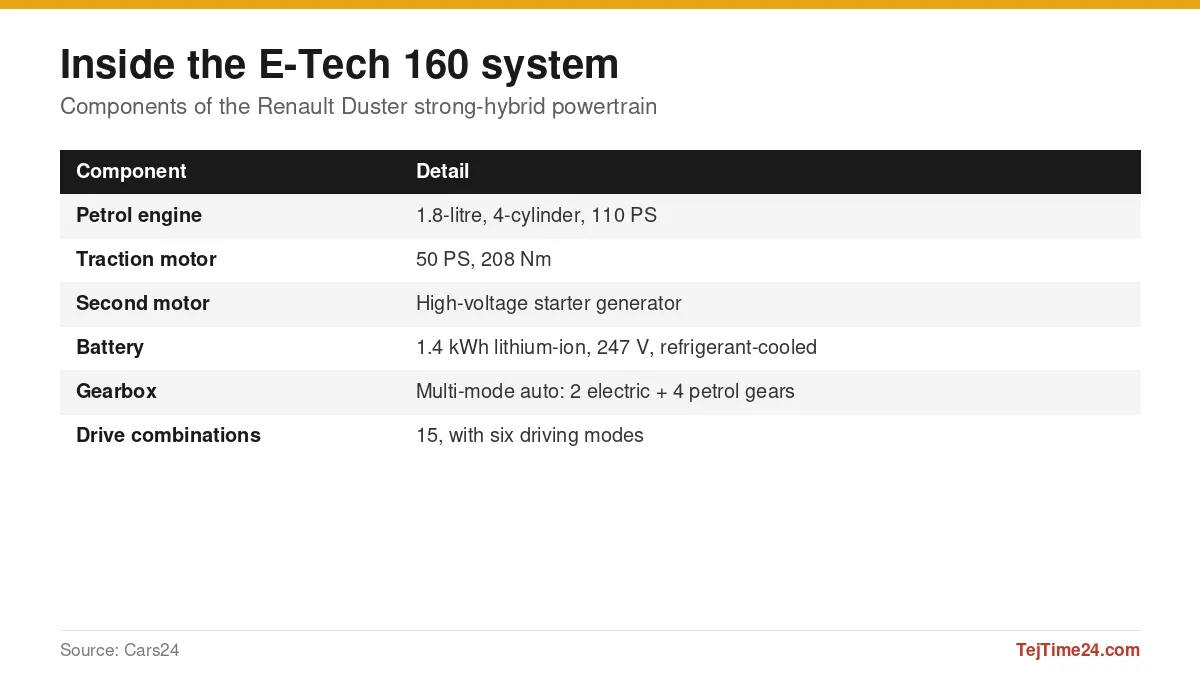
Renault’s E-Tech system differs from the hybrids sold by Toyota and Maruti Suzuki, and it is unusual in its design.
- Petrol engine: a 1.8-litre, four-cylinder unit (1,789 cc) producing 110 PS.
- Traction motor: a 50 PS electric motor with 208 Nm of peak torque that drives the wheels.
- Starter generator: a second, high-voltage motor that starts the engine, charges the battery and smooths gear changes.
- Battery: a 1.4 kWh lithium-ion pack operating at 247 V, cooled by refrigerant.
- Gearbox: a multi-mode automatic with two electric gears and four petrol gears, giving 15 possible drive combinations.
Together, the system produces a maximum of 160 PS, which is where the E-Tech 160 name comes from. Renault has not confirmed the combined torque figure.
This is a self-charging hybrid, so there is no plug. The battery is recharged by the engine and by regenerative braking. The car always starts in electric mode, and it can run on electric power alone for short distances at low speeds. Renault claims up to 80 percent of city driving can be done in electric mode, which explains the high efficiency figure.
Mileage and range
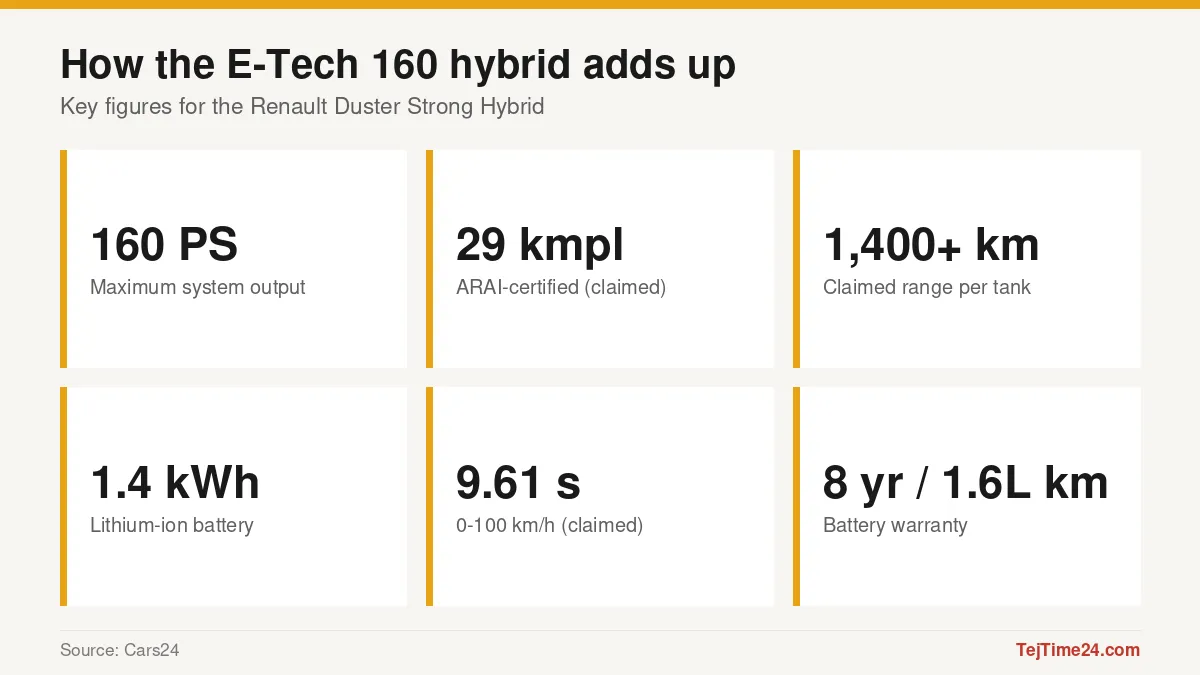
Renault claims an ARAI-certified fuel efficiency of 29 kmpl and a range of more than 1,400 km on a full tank. These are test-cycle figures, and real-world numbers will be lower, particularly on highways at high speed, where the electric motor contributes less.
The hybrid’s real strength is in city traffic. In stop-start conditions, the car can creep along on electric power, recover energy under braking and switch the engine off when it is not needed. That is precisely where a conventional petrol SUV is least efficient. Buyers who spend most of their time in congested cities should see the biggest gap between the hybrid and the turbo-petrol versions.
Performance and drive modes
Renault claims a 0-100 km/h time of 9.61 seconds, which is respectable for a family SUV focused on efficiency. The instant torque from the electric motor should make the Duster Hybrid feel responsive when pulling away from traffic lights.
There are six driving modes, including an E-Save mode that preserves battery charge, and a B mode that increases regenerative braking. B mode lets drivers slow the car more by lifting off the accelerator, recovering more energy in the process. It is particularly useful in city traffic and on downhill stretches.
Features
The Duster Hybrid’s features include:
- A 10.1-inch infotainment screen and a 10.25-inch TFT driver display
- A six-speaker sound system and wireless smartphone charging
- An electric panoramic sunroof and a power tailgate
- Dual-zone automatic climate control and push-button start
- LED lighting and 18-inch alloy wheels
The top Emotion variant adds dune brown leatherette upholstery, ventilated front seats and six-way power-adjustable front seats. The Techno variant uses desert beige semi-leatherette seats. Since feature distribution across variants can differ, buyers should check the exact specification of each trim with their dealer.
Safety and warranty
Renault says the Duster Hybrid comes with 35 standard safety features. They include six airbags, electronic stability programme, tyre pressure monitoring, hill-hold assist, ISOFIX child-seat mounts and an electric parking brake with auto-hold.
Warranty coverage is a strong point and should reassure buyers who are wary of hybrid technology.
- Hybrid battery: 8 years or 1,60,000 km
- Vehicle: 7 years or 1,50,000 km under the Renault Forever programme
Concerns about battery replacement costs are one of the main reasons buyers hesitate over hybrids. An eight-year battery warranty covers most of a typical ownership period, which removes much of that worry.
Rivals: Hyryder, Grand Vitara and Victoris
The Duster Strong Hybrid takes on three established strong-hybrid SUVs:
- Toyota Urban Cruiser Hyryder
- Maruti Suzuki Grand Vitara
- Maruti Suzuki Victoris
These rivals share a Toyota-developed hybrid system that has built a strong reputation for efficiency and reliability in India. The Duster’s case rests on its bigger 1.8-litre engine, its 160 PS system output, its distinctive multi-mode gearbox, its long warranty and its competitive starting price. Toyota and Maruti have the advantage of much larger service networks and a longer track record with hybrids in India. Buyers should test-drive the Duster and at least one rival back to back, ideally in city traffic, where the differences between hybrid systems are most noticeable.
Why strong hybrids are gaining ground in India
Strong hybrids occupy a useful middle ground for Indian buyers. They deliver much better fuel efficiency than conventional petrol cars, especially in city traffic, but they do not depend on charging infrastructure the way electric cars do. Owners simply fill up with petrol as usual. That makes them a practical choice in cities where home charging is difficult, for example in older apartment buildings without dedicated parking.
Until now, buyers in the mid-size SUV segment have had relatively few strong-hybrid choices, and most have shared the same underlying technology. The Duster Hybrid adds a genuinely different system to the mix, with its own gearbox design and a larger engine. More competition in this space is good news for buyers, as it is likely to push prices down and features up across the segment over the next few years.
Hybrid or turbo-petrol Duster?
With the turbo-petrol Duster starting at Rs 10.49 lakh, the hybrid costs considerably more. Which one makes sense depends on how the car will be used.
- Choose the hybrid if you drive long distances in city traffic, want the lowest running costs, prefer a smooth automatic, and plan to keep the car for many years.
- Choose the turbo-petrol if your annual mileage is modest, you do mostly highway driving, or the lower purchase price matters more than long-term savings.
A simple rule applies: the more you drive, especially in traffic, the faster the hybrid repays its higher price.
Quick answers
Does the Duster Hybrid need to be plugged in?
No. It is a self-charging strong hybrid. The battery is charged by the engine and by regenerative braking.
What is the claimed mileage?
Renault claims an ARAI-certified 29 kmpl and a range of more than 1,400 km on a full tank.
When do deliveries start?
Renault says deliveries will begin on 6 November 2026. Bookings are open for Rs 21,000.
How long is the battery warranty?
Eight years or 1,60,000 km.
Verdict
The Renault Duster Strong Hybrid E-Tech 160 is a serious challenger in India’s strong-hybrid SUV market. Its introductory price of Rs 16.99 lakh undercuts expectations, its claimed 29 kmpl matches the best in its class, and its long battery and vehicle warranties address buyers’ biggest worries about hybrid ownership. The unusual multi-mode gearbox and 160 PS system output give it a distinct character among its rivals.
The main unknowns are real-world efficiency and how Renault’s hybrid technology holds up over years of Indian use, areas where Toyota and Maruti have a proven record. For buyers who want a fuel-efficient, well-equipped and well-warranted family SUV, the Duster Hybrid deserves a place on the shortlist.
Sources
- Cars24: Renault Duster Hybrid launched at Rs 16.99 lakh
- Autocar Professional: Duster Strong Hybrid deliveries from 6 November
- DriveSpark: Duster Hybrid variants and prices
- CarLelo: Duster price expectations and turbo-petrol pricing
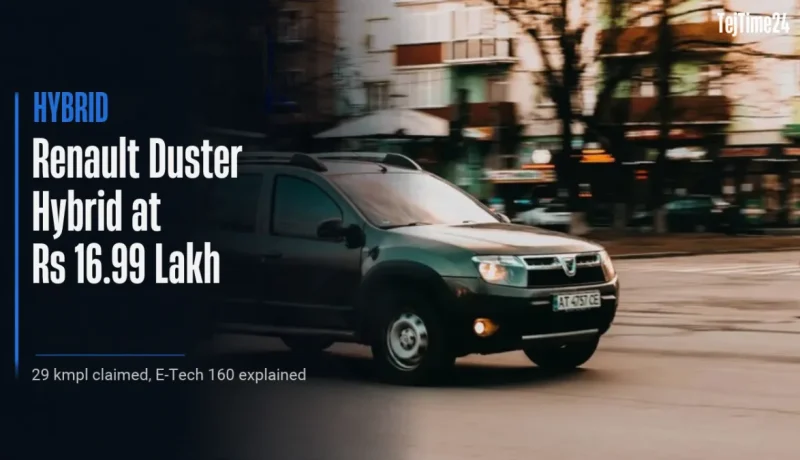
Featured image designed by TejTime24 in Canva using a representative photo of an earlier-generation Renault Duster. Photo: Liubomyr Vovchak / Unsplash.
Related: 2026 Toyota Glanza facelift launched | Mahindra XUV 3XO CNG launched