

2026 Toyota Glanza Facelift Launched at Rs 6.99 Lakh: New Engine, Mileage, ADAS and Prices

Toyota has launched the 2026 Glanza facelift in India with prices starting at Rs 6.99 lakh (ex-showroom). The premium hatchback follows the Maruti Suzuki Baleno it is based on into its mid-life update, and it brings the same headline changes: a new three-cylinder petrol engine, better claimed fuel efficiency and a feature list that now includes Level 2 ADAS and ventilated front seats.
Table Of Content
The Glanza’s appeal has always been simple. It offers Baleno engineering with Toyota’s badge, warranty reputation and service network. The question with the facelift is whether the new engine and added equipment are worth the higher entry price. This guide covers the prices, the engine change, mileage, features, safety and how the Glanza stacks up against its rivals.
2026 Toyota Glanza price list
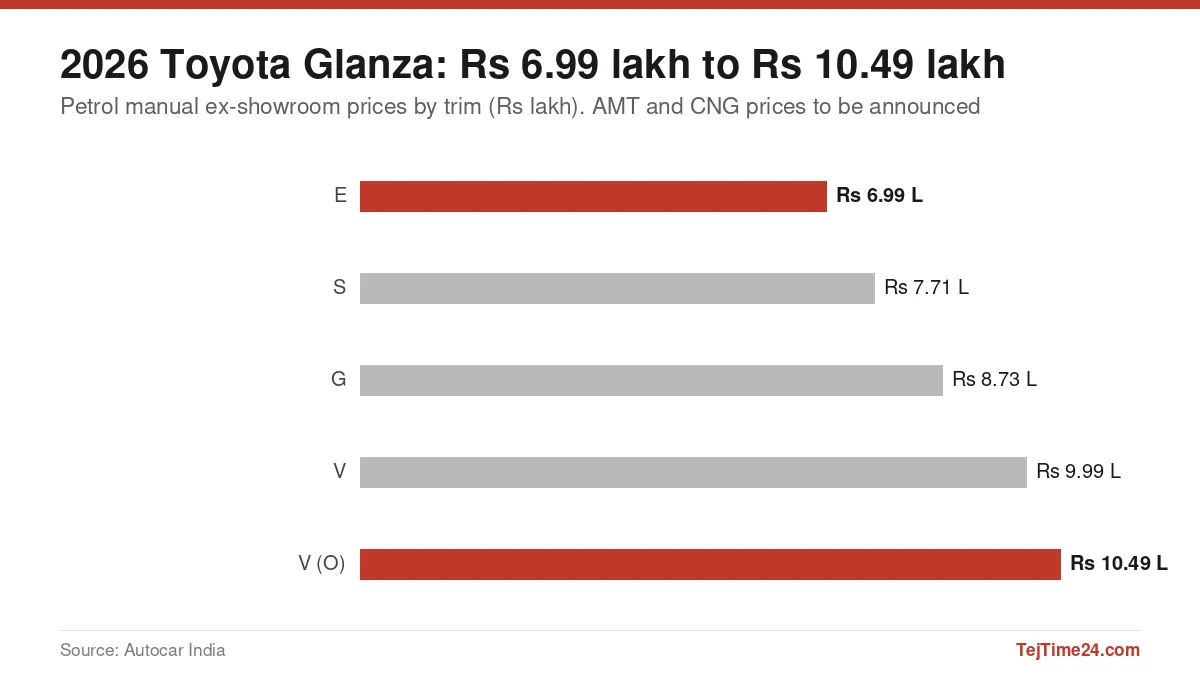
The facelifted Glanza is sold in five trims: E, S, G, V and V (O). At launch, Toyota announced prices for the petrol manual versions only. Petrol AMT and CNG prices are still to come.
| Trim | Petrol manual (ex-showroom) |
|---|---|
| E | Rs 6.99 lakh |
| S | Rs 7.71 lakh |
| G | Rs 8.73 lakh |
| V | Rs 9.99 lakh |
| V (O) | Rs 10.49 lakh |
Before the facelift, the Glanza was priced from roughly Rs 6.73 lakh to Rs 9.99 lakh. That means the entry price has gone up by about Rs 26,000. The new range-topping V (O) trim now crosses the Rs 10 lakh mark, which puts the most expensive Glanza into the territory of some compact SUVs. Buyers should expect the AMT and CNG versions, once priced, to sit above the equivalent manuals.
The new three-cylinder engine
The biggest mechanical change is under the bonnet. The old four-cylinder engine has been replaced by Maruti Suzuki’s new 1.2-litre, three-cylinder Z12E naturally aspirated petrol engine, the same unit introduced in the Baleno facelift.
- Petrol: 83 hp and 112 Nm, with a five-speed manual or five-speed AMT. That is 7 hp and 1 Nm less than the old engine.
- CNG: 70 hp and 102 Nm. Power is down 7 hp, but torque is up by 4.5 Nm.
- Idle start/stop is now part of the petrol package.
- A five-speed AMT is now available with CNG for the first time.
On paper, the new engine gives up a little power. In return, it promises better fuel efficiency, which for most hatchback buyers matters far more than a few horsepower. Three-cylinder engines can feel slightly less refined than four-cylinder units at idle and low speeds, so buyers moving from an older Glanza should take a test drive before deciding.
Mileage: old vs new
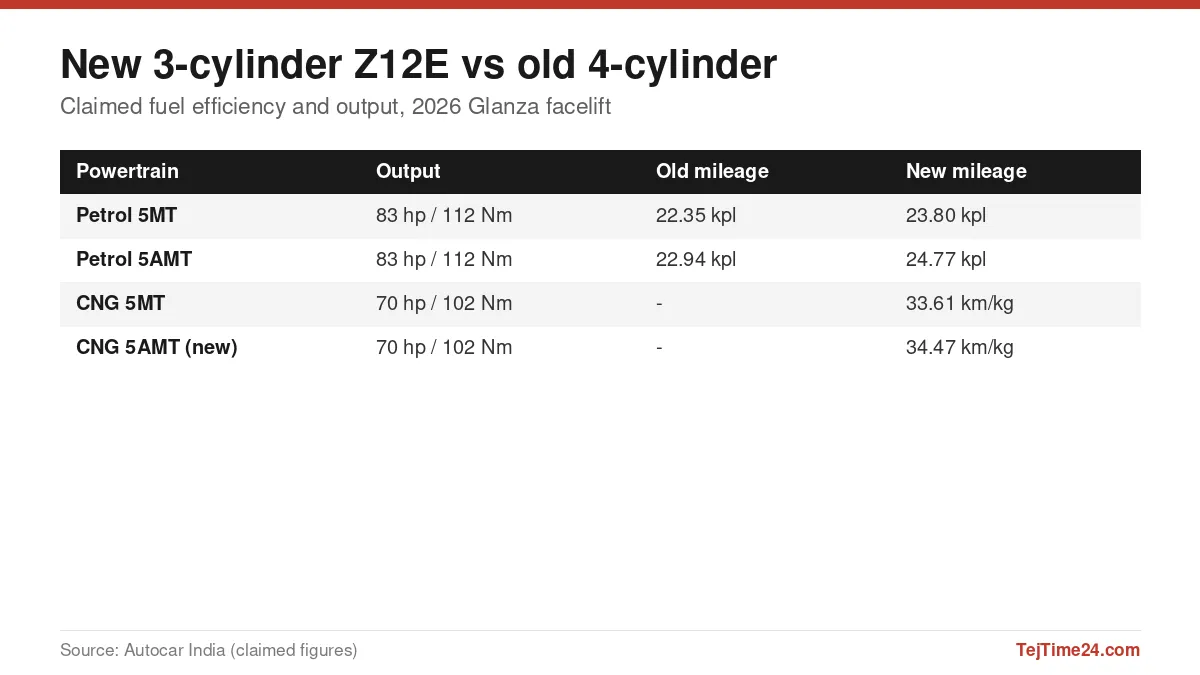
The Z12E’s main selling point is efficiency. According to the claimed figures, the petrol manual now returns 23.80 kpl, up from 22.35 kpl. The petrol AMT climbs to 24.77 kpl from 22.94 kpl. The CNG versions are rated at 33.61 km/kg with the manual and 34.47 km/kg with the new AMT.
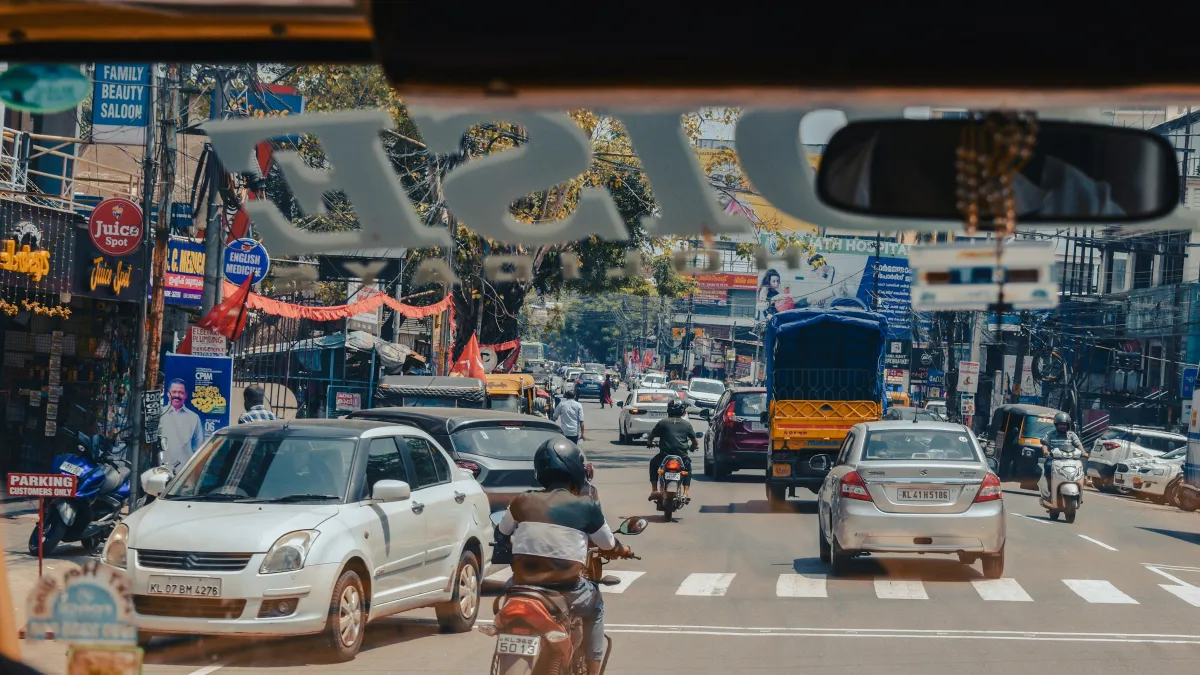
As always, these are test-cycle figures, and real-world numbers will vary with traffic, driving style and load. The relative improvement is still meaningful. For a buyer who covers 15,000 km a year, a gain of around 1.5 to 2 kpl adds up to noticeable fuel savings over the life of the car. The new CNG automatic is also significant. It gives buyers in congested cities the low running costs of CNG without the fatigue of working a clutch in stop-start traffic.
Design changes
The styling updates are subtle and concentrated at the front.
- A larger grille with satin-finished trim.
- Redesigned LED fog lamps.
- The Toyota logo has been repositioned to the edge of the bonnet.
- A shark-fin antenna is now offered.
- Two new colours: Digital Teal Green and Bluish Black.
The headlamps, the side profile with its 16-inch alloy wheels and chrome door handles, and the rear design remain largely unchanged. Owners of the outgoing car will recognise the new Glanza immediately, which is probably what Toyota intended.
New features
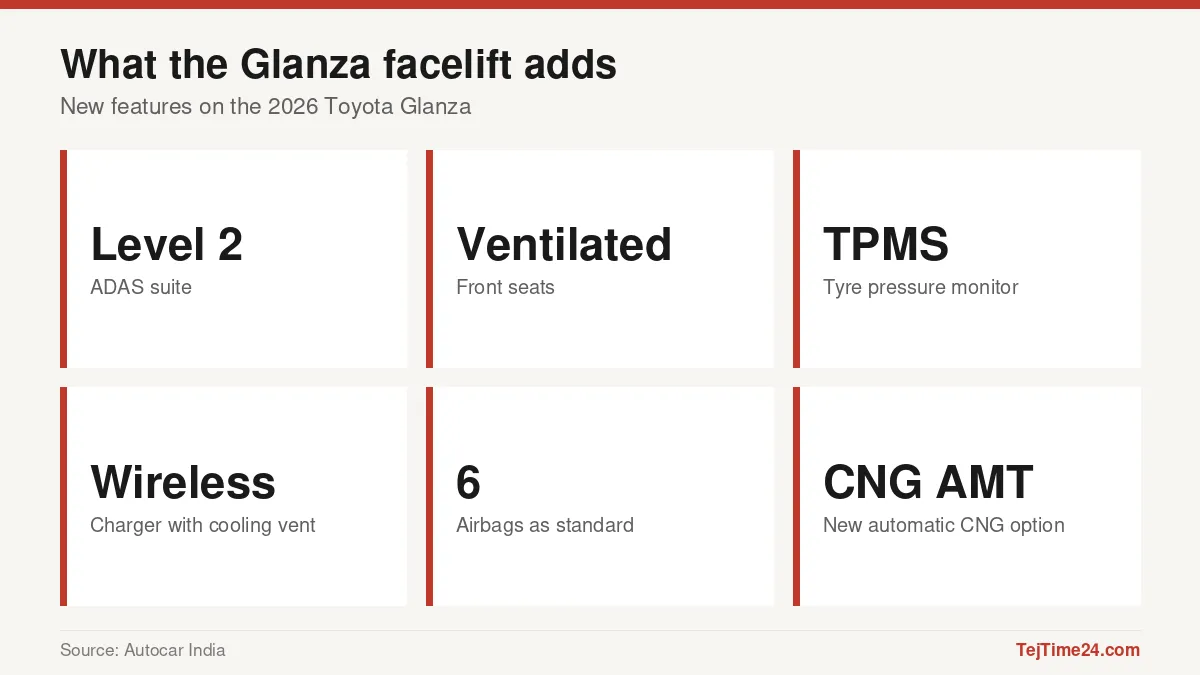
The dashboard layout is unchanged, but Toyota has added a useful set of features that bring the Glanza closer to more expensive cars.
- Ventilated front seats, a genuinely welcome addition for Indian summers and still rare in this segment.
- New leatherette upholstery.
- Wireless phone charger with a cooling vent underneath to stop phones overheating.
- Clarion sound system with four speakers and two tweeters.
- Tyre pressure monitoring system (TPMS).
These additions sit alongside carried-over equipment, including a 9-inch touchscreen, a head-up display, analogue dials with a colour multi-information display, and automatic climate control with rear AC vents.
Safety and ADAS
Safety was already a Glanza strength, with six airbags as standard. The facelift keeps those along with a 360-degree camera, hill-hold control and ISOFIX child-seat mounts. The big addition is a Level 2 ADAS suite, which uses cameras and radar to support features such as collision warning and lane assistance. Toyota has also added TPMS.
Level 2 ADAS in a sub-Rs 10 lakh hatchback was unthinkable only a few years ago. Buyers should check which trims get the full ADAS package. As is usual in this segment, the most advanced equipment tends to be reserved for the top variants.
Glanza vs Baleno, i20 and Altroz
The Glanza competes in one of India’s most crowded segments.
- Maruti Suzuki Baleno: the Glanza’s mechanical twin, also facelifted with the Z12E engine and Level 2 ADAS. It is priced from Rs 5.99 lakh to Rs 9.99 lakh, which makes it significantly cheaper at the entry level.
- Hyundai i20 and i20 N Line: priced from Rs 6 lakh to Rs 11.64 lakh, with a sportier N Line option for enthusiasts.
- Tata Altroz: priced from Rs 6 lakh to Rs 10.90 lakh, with a reputation for strong build quality.
The Glanza versus Baleno decision often comes down to brand preference, dealer experience and the offers available at the time of purchase. Mechanically, the two cars are near-identical. The Baleno’s lower starting price is a clear advantage for budget buyers. The Glanza counters with Toyota’s ownership experience, which many buyers value highly.
Which trim should you buy?
- E (Rs 6.99 lakh): for buyers on a strict budget who want six airbags and the new efficient engine.
- S (Rs 7.71 lakh): a sensible step up that adds more convenience equipment without a big jump in price.
- G (Rs 8.73 lakh): likely the sweet spot for most families, balancing features and cost.
- V and V (O) (Rs 9.99 lakh and Rs 10.49 lakh): for buyers who want the full feature list, including the premium additions that make the facelift stand out.
Buyers who drive mostly in the city and want the lowest running costs should wait for the CNG AMT prices before deciding. It could be the most practical Glanza of all.
Running costs and ownership
The Glanza’s real advantage over many rivals lies in what it costs to own over several years, not just its sticker price. The better claimed mileage of the Z12E engine reduces fuel bills, and the CNG options cut running costs further for buyers who have easy access to CNG stations. Because the Glanza shares its mechanical parts with the Baleno, spare parts are widely available and generally affordable across India.
Toyota’s service network, combined with Maruti Suzuki’s parts supply chain, means maintenance should be straightforward even in smaller towns. Resale value is another consideration. Premium hatchbacks from established brands tend to hold their value well in India’s used-car market, and a well-maintained Glanza should be easy to sell when the time comes.
Buyers comparing on-road prices should remember to factor in insurance, registration and accessories. These can add a significant amount to the ex-showroom figure, and they vary from state to state.
Should existing Glanza owners upgrade?
For owners of a Glanza bought in the last two or three years, the case for upgrading is not overwhelming. The design changes are mild, and the outgoing four-cylinder engine is smoother and slightly more powerful. The main reasons to switch would be the Level 2 ADAS suite, ventilated front seats, better fuel efficiency and the new CNG automatic.
Owners of older Glanza models, or buyers coming from an entry-level hatchback, will notice a much bigger difference. For them, the facelift offers a substantial step up in safety technology and comfort while keeping running costs low.
Verdict
The 2026 Toyota Glanza facelift is a sensible, well-judged update. The new three-cylinder engine trades a little power for better fuel efficiency, the CNG AMT fills a real gap, and the new features, particularly ventilated seats and Level 2 ADAS, make the Glanza feel more modern. The main drawbacks are a higher starting price and the fact that the cheaper Baleno offers almost the same car.
For buyers who want a fuel-efficient, well-equipped premium hatchback with Toyota’s ownership experience, the facelifted Glanza is an easy recommendation.
Sources
- Autocar Professional: 2026 Toyota Glanza facelift launched, priced from Rs 6.99 lakh
- Autocar India: 2026 Toyota Glanza facelift launched
- Times Drive: pre-facelift Glanza price range
- Spinny: Glanza facelift dimensions
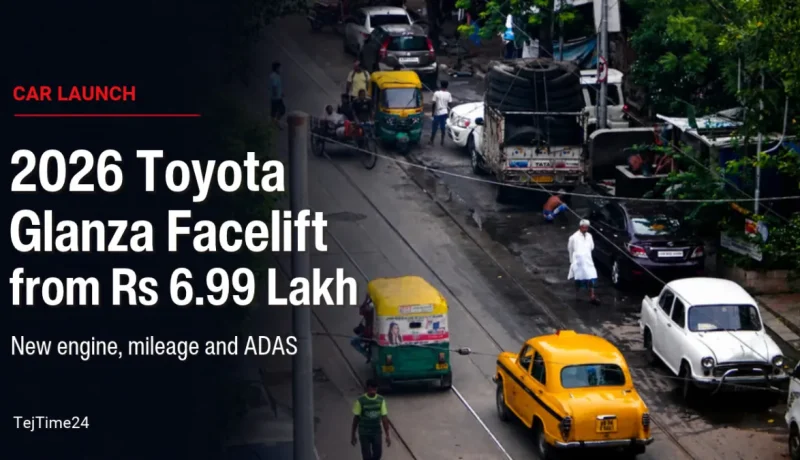
Featured image designed by TejTime24 in Canva using a representative photo of a city street in Kolkata. Photo: Harsh Aryan / Unsplash.
Related: Mahindra Thar OG launched at Rs 10.32 lakh | 2026 Mercedes-Maybach S-Class launched at Rs 3.35 crore