


Honda Cars India has launched the 2026 Honda Elevate facelift at a starting price of Rs 11.80 lakh (ex-showroom), which is an introductory price. This is the first major update to Honda’s mid-size SUV since it went on sale in India in 2023. The changes include a sharper front end, a light bar at the back, a cabin with a fresh look and a list of new features. The headline addition is ventilated rear seats, which Honda calls a first for the segment.
Table Of Content
- Price and variants
- Design changes
- Interior and new features
- Engine, gearbox and mileage
- Safety and Honda Sensing ADAS
- Which variant should you buy?
- Rivals: Creta, Seltos, Kushaq and Grand Vitara
- What is still missing
- Quick answers
- What is the price of the Honda Elevate facelift?
- Does the Elevate facelift get a hybrid?
- What is the Elevate facelift’s mileage?
- What is the main new feature?
- How much is the booking amount?
- Verdict
- Sources
The mechanical package has not changed. The Elevate still uses only Honda’s 1.5-litre naturally aspirated petrol engine, offered with a manual gearbox or a CVT automatic. The entry price is also the same as before, while the top of the range is now Rs 1.94 lakh dearer, a gap that reflects the new ZX+ trim and its extra equipment. Below is a full guide to the prices, the design and feature changes, the engine, safety, and how the Elevate now compares with the Hyundai Creta, Kia Seltos and their rivals.
Price and variants
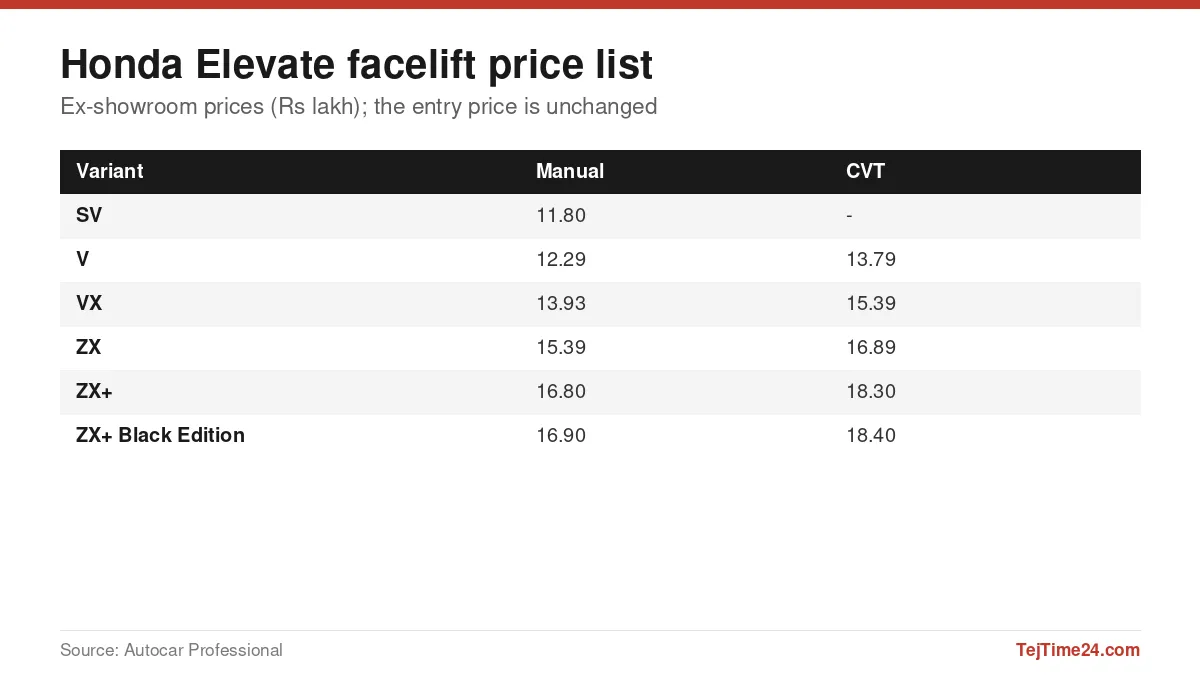
The facelifted Elevate comes in five main trims: SV, V, VX, ZX and the new ZX+. The ZX+ is also offered as a Black Edition. The base SV is manual-only, while every other trim gives buyers the choice of a six-speed manual or a CVT.
| Variant | Manual | CVT |
|---|---|---|
| SV | Rs 11.80 lakh | – |
| V | Rs 12.29 lakh | Rs 13.79 lakh |
| VX | Rs 13.93 lakh | Rs 15.39 lakh |
| ZX | Rs 15.39 lakh | Rs 16.89 lakh |
| ZX+ | Rs 16.80 lakh | Rs 18.30 lakh |
| ZX+ Black Edition | Rs 16.90 lakh | Rs 18.40 lakh |
All prices are ex-showroom and introductory, so they may rise after the launch period. Honda opened pre-bookings on 1 October 2026 for a token amount of Rs 21,000, five days before the launch.
The pricing tells a clear story. Honda has held the entry point steady, so buyers on a budget are not penalised by the update. The extra cost sits at the top of the range, where the new ZX+ trim carries most of the added features. The CVT costs about Rs 1.5 lakh more than the manual across the line-up, which is in line with what rivals charge for an automatic.
Design changes
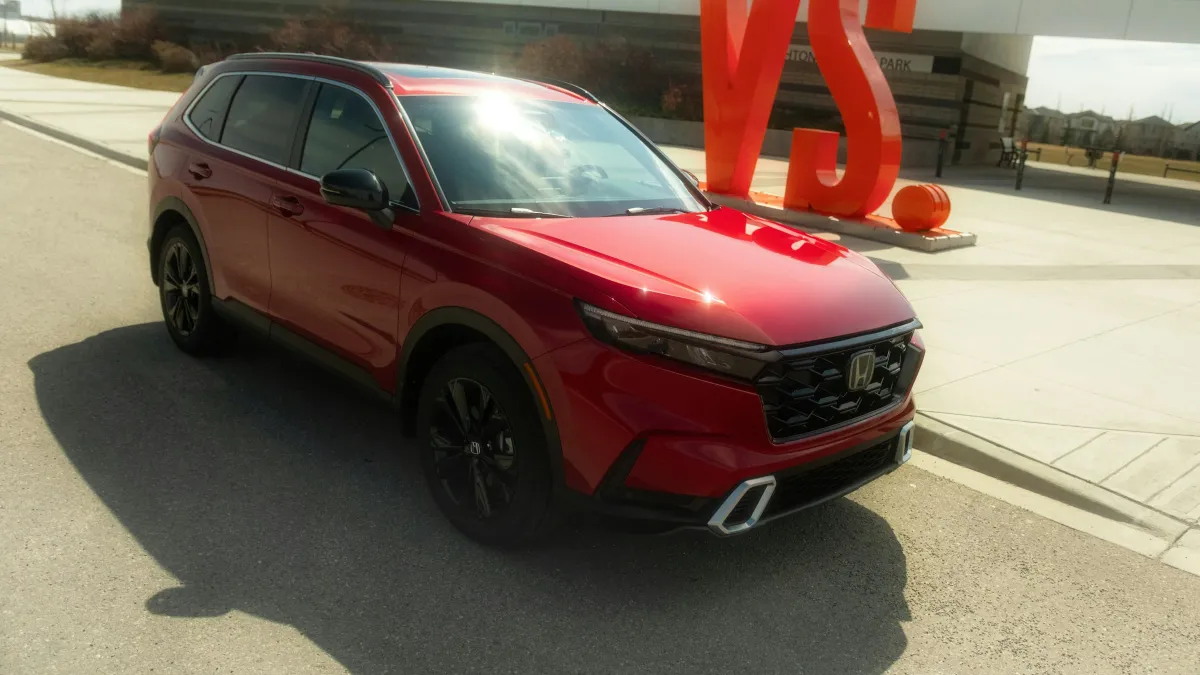
The Elevate keeps its upright, boxy shape, but the details at both ends are new. At the front:
- A segmented LED daytime running light strip now runs above the grille and links the LED headlamps.
- The grille has a new mesh pattern with a gloss-black finish.
- The fog-lamp housings are now body-coloured.
- The Honda logo has moved from the grille to the leading edge of the bonnet.
At the rear, an LED light bar now connects the tail-lamps, a design trend that has spread quickly through the segment. The body cladding around the wheel arches and lower edges is now gloss black instead of matte, which gives the SUV a more polished look. Honda has also added a new colour called Nordic Forest Pearl, offered in both single-tone and dual-tone finishes.
None of these changes alters the Elevate’s basic proportions, but together they bring its styling closer to newer rivals that lean heavily on connected lighting.
Interior and new features
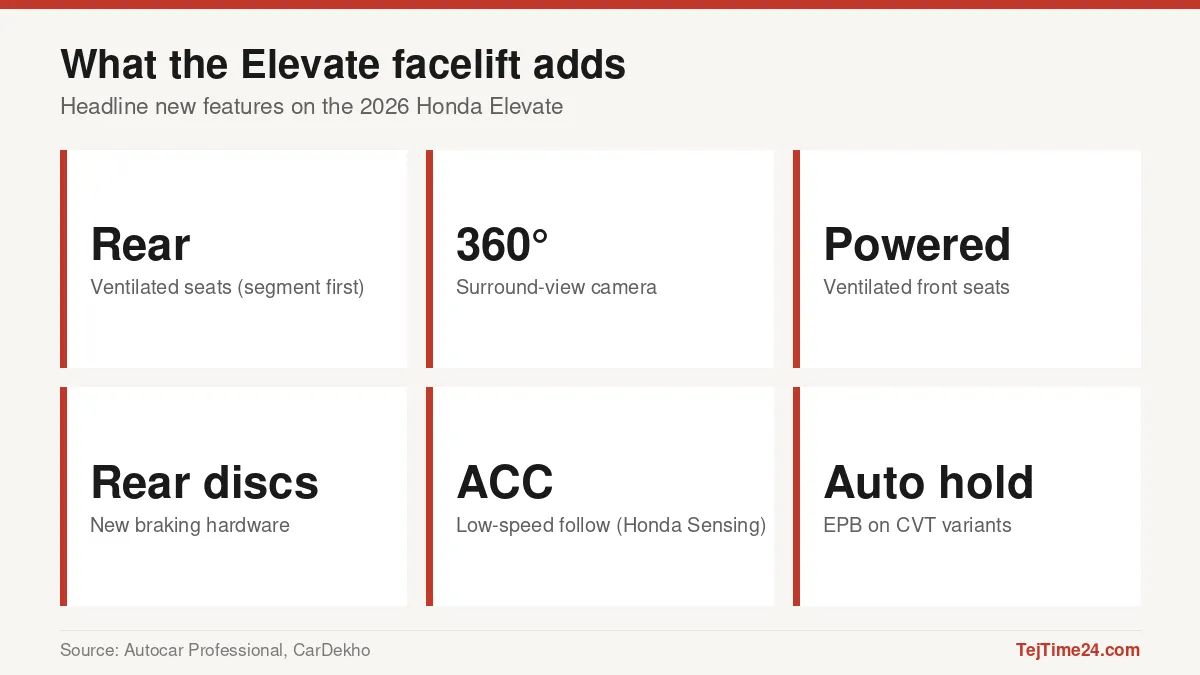
Before the facelift, the Elevate was often criticised for lagging its rivals on features, even though it was praised for space, comfort and its refined engine. This update is Honda’s attempt to close that gap. The main new features are:
- Ventilated rear seats, which Honda says is a segment first
- Powered and ventilated front seats
- A 360-degree camera
- Front parking sensors
- An electronic parking brake with auto hold (CVT variants only)
- Capacitive-touch rear LED reading lamps
- Factory-fitted ambient lighting on higher variants
The dashboard trim has also changed. A white leatherette finish replaces the earlier faux-wood panel, which gives the cabin a lighter, more modern feel. Honda says it has also added extra sound-deadening material to reduce noise inside the cabin, although that claim will need to be tested on the road.
Several features carry over from the outgoing model:
- A 10.25-inch touchscreen infotainment system with smartphone connectivity
- A semi-digital instrument cluster
- A single-pane sunroof
- Honda’s LaneWatch camera
- A wireless charger
Ventilated rear seats are a genuinely useful addition in Indian summers, especially for families who carry passengers in the back on long trips. The 360-degree camera and front sensors also help with parking in tight city spaces, which was a weakness of the earlier Elevate.
Engine, gearbox and mileage
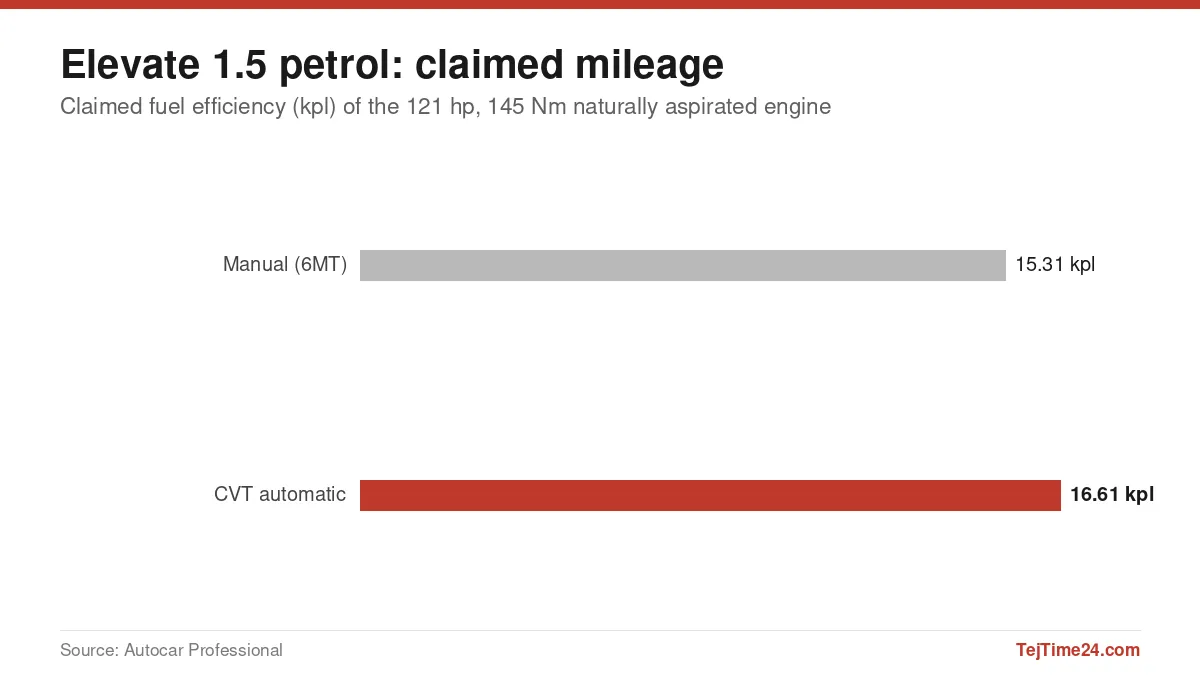
The engine is unchanged. The Elevate uses a 1.5-litre naturally aspirated four-cylinder petrol engine with 121 hp and 145 Nm of torque.
| Gearbox | Claimed mileage |
|---|---|
| 6-speed manual | 15.31 kpl |
| CVT automatic | 16.61 kpl |
There is still no hybrid. Honda’s 1.5-litre strong-hybrid system, which is offered in the City sedan, has not been added to the Elevate. There is also no turbo-petrol or diesel engine, so buyers who want more power or higher efficiency will need to look elsewhere.
Honda’s naturally aspirated engine is known for its smoothness and its refinement at higher revs. The CVT is the better choice for buyers who drive mostly in the city, and it is also the more efficient option on paper. Enthusiasts may prefer the manual for the extra control it gives, although many buyers in this segment now choose automatics.
Safety and Honda Sensing ADAS
The facelift improves the Elevate’s safety equipment in three ways:
- Six airbags carry over from the earlier model.
- Rear disc brakes are new, replacing drums at the rear.
- The Honda Sensing ADAS suite now includes adaptive cruise control with low-speed follow.
Low-speed follow is the most practical change for Indian roads. Earlier adaptive cruise systems often switched off below a certain speed, which made them less useful in heavy traffic. With low-speed follow, the system can keep a set gap from the vehicle ahead even in slow-moving traffic, which reduces driver fatigue in congested cities.
Rear disc brakes should also give better braking consistency, particularly when the car is fully loaded or on long downhill runs.
Which variant should you buy?
With six price points and two gearboxes, it helps to match the trim to your needs.
- SV (Rs 11.80 lakh): The cheapest way into an Elevate, but it is manual-only. It suits buyers who mainly want Honda’s space, engine and build quality at the lowest price.
- V (from Rs 12.29 lakh): The most affordable trim with a CVT option. A sensible choice for city buyers who want an automatic without paying for top-end features.
- VX (from Rs 13.93 lakh): A middle-ground trim that balances price and equipment. Buyers should confirm with the dealer which new features are included at this level.
- ZX (from Rs 15.39 lakh): The trim to consider if you want a well-equipped Elevate without paying for the very top variant.
- ZX+ and ZX+ Black (from Rs 16.80 lakh): These trims carry the facelift’s headline features and give the fullest version of what the updated Elevate offers.
Because feature distribution across trims can be complex, buyers should ask the dealer for the official variant-wise feature list before booking. This is especially important for features such as ventilated rear seats and the 360-degree camera, which may be limited to higher trims.
Rivals: Creta, Seltos, Kushaq and Grand Vitara
The Elevate competes in one of India’s most crowded segments. Its main rivals include:
- Hyundai Creta
- Kia Seltos
- Skoda Kushaq
- Maruti Suzuki Grand Vitara
Most of these rivals offer a wider choice of engines, including turbo-petrol, diesel or strong-hybrid powertrains. The Elevate’s single-engine line-up is its main weakness on paper. Its strengths are a reputation for reliability and refinement, a spacious cabin and a practical boot. With this update, it also has a feature list that is far more competitive than before, led by ventilated rear seats.
For buyers who want a petrol automatic and do not need a turbo engine, the Elevate makes a strong case. Those who want maximum performance, a diesel, or the efficiency of a hybrid will find better-suited options elsewhere in the segment.
What is still missing
The facelift fixes many of the Elevate’s earlier shortcomings, but a few gaps remain:
- No hybrid or turbo engine: The lack of powertrain choice is the biggest limitation, especially as rivals offer more options.
- Single-pane sunroof: Many rivals now offer panoramic sunroofs, which buyers in this segment often ask for.
- Semi-digital instrument cluster: Several competitors have moved to fully digital displays.
- Auto hold on CVT only: The electronic parking brake with auto hold is limited to automatic versions.
For some buyers, these gaps will not matter, especially those who value refinement and Honda’s after-sales reputation. For others, especially buyers who compare spec sheets closely, they may tip the decision towards a rival.
Quick answers
What is the price of the Honda Elevate facelift?
Prices start at Rs 11.80 lakh for the SV manual and go up to Rs 18.40 lakh for the ZX+ Black Edition CVT (ex-showroom, introductory).
Does the Elevate facelift get a hybrid?
No. It continues with only the 1.5-litre naturally aspirated petrol engine, paired with a manual or CVT gearbox.
What is the Elevate facelift’s mileage?
Honda claims 15.31 kpl for the manual and 16.61 kpl for the CVT.
What is the main new feature?
Ventilated rear seats, which Honda calls a first in the segment. The facelift also adds a 360-degree camera, powered and ventilated front seats and adaptive cruise control with low-speed follow.
How much is the booking amount?
Pre-bookings opened on 1 October 2026 for Rs 21,000.
Verdict
The 2026 Honda Elevate facelift addresses the most common complaint against the SUV: that it did not offer enough features for its price. Ventilated rear seats, a 360-degree camera, powered front seats, rear disc brakes and smarter adaptive cruise control bring it much closer to the competition. The styling updates are modest but effective, and keeping the entry price at Rs 11.80 lakh makes the update easy to recommend for budget-conscious buyers.
The Elevate still asks buyers to accept a single petrol engine in a segment full of choice. If that suits your needs, the updated Elevate is now a more complete, well-rounded family SUV and is well worth a test drive.
Sources
- Autocar Professional: Honda Elevate facelift launched at Rs 11.80 lakh
- DriveSpark: Elevate facelift trims and pricing
- Autocar India: Elevate facelift pre-bookings open
- CarDekho: Honda Elevate facelift
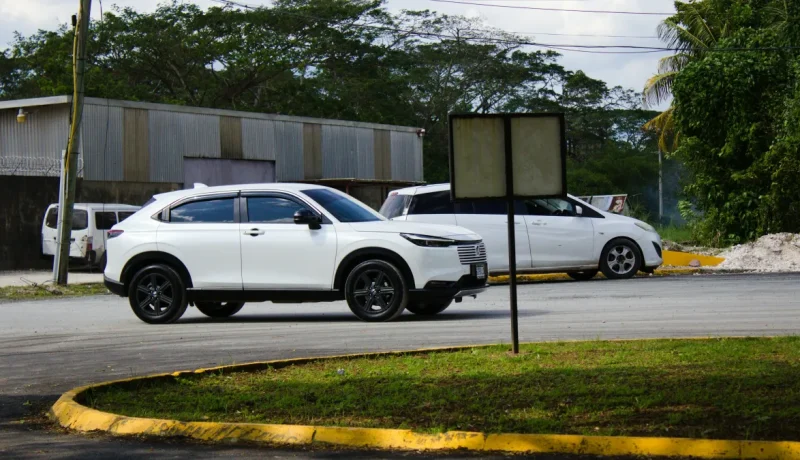
Featured image is a representative photo of a Honda crossover SUV, not the Elevate facelift. Photo: Kern Morris / Unsplash.
Related: 2026 Toyota Glanza facelift launched | Renault Duster Strong Hybrid launched